



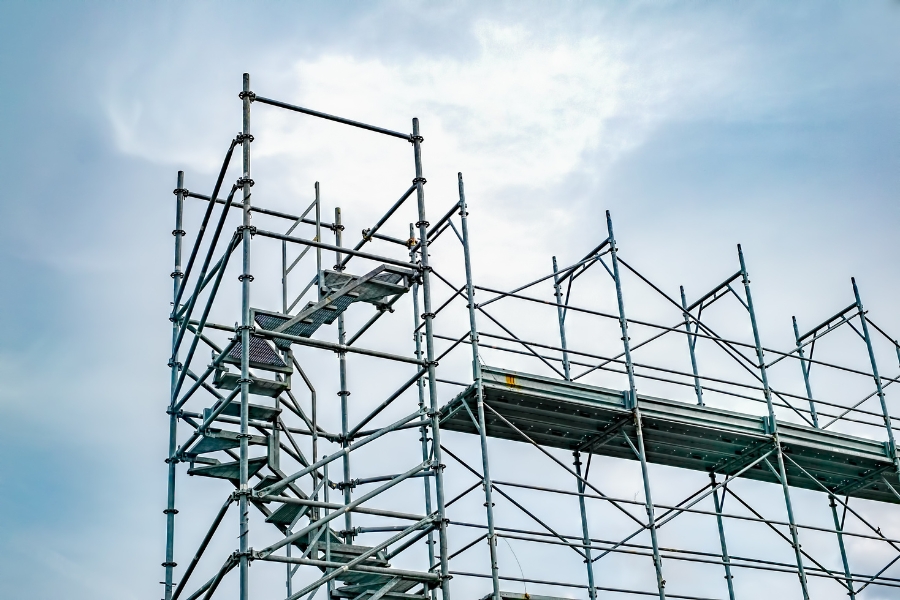
Are you working on a construction project and faced with two scaffolding options: classic but inexpensive bamboo scaffolding, or sturdy but expensive steel scaffolding? Well, this dilemma is not just about price, but also about safety and work efficiency in the field. Many people may think that bamboo is strong enough, but is that really the case?
Well, we will thoroughly examine the bamboo vs. iron scaffolding competition from various angles, starting from strength, service life, to cost efficiency. So, before deciding which one is more suitable for your project, let’s analyze the advantages and risks of these two popular materials one by one!
What is a Steger?
A steger, also known as scaffolding, functions as a temporary support structure so that workers can work at heights safely and comfortably. In addition, steger also helps hold materials and loads during the construction process.
Generally, steger is divided into two main types, namely bamboo and iron. Let’s review them one by one!
Advantages and Disadvantages of Bamboo Scaffolding
Bamboo scaffolding has long been a mainstay in the construction world, especially for small to medium-scale projects. Although it looks simple, it has its own advantages that make it still widely used today. But of course, there are also disadvantages. What are they?
Advantages
1. More affordable price
Because the material is relatively natural and easy to obtain, the cost of bamboo scaffolding materials tends to be cheaper than steel.
2. Structural flexibility
Bamboo has a slight flexibility under certain loads, so that when there are slight vibrations or small movements, the bamboo can adjust without immediately cracking.
3. Environmentally friendly
The use of bamboo can be more environmentally friendly than steel, as long as it is processed and harvested sustainably.
Disadvantages
Low resistance to moisture, insects, and fungi.
Service life is often limited to one use.
Not suitable for large-scale or tall projects due to strength limitations.
Requires more intensive installation and cutting work.
Advantages and Disadvantages of Iron Stegers
Compared to bamboo, iron steger is known to be much more modern and sturdy. But like bamboo, iron steger also has its own advantages and disadvantages that you need to consider before using it.
Advantages
1. High strength and durability
Iron, especially galvanized steel or strong alloys, can withstand heavy loads and repeated use.
2. Long service life
Due to the nature of the material, iron scaffolding can be used many times as long as it is still in good condition.
3. Standardization and ease of installation
Iron scaffolding (scaffolding sets) are usually designed to be modular and come in standard sizes, making installation relatively quick and systematic.
4. Lesser maintenance
With good rust protection, iron is more resistant to weather and corrosion than bamboo.
Disadvantages
The initial cost tends to be higher.
If there are errors in installation or connection, the safety risk is very high.
The weight itself can be a problem for transportation and installation.
Comparison of Bamboo vs Iron Scaffolding
In the world of construction, safety and efficiency are non-negotiable factors. Both bamboo and iron scaffolding have their own characteristics and risks when used in the field. Before making a choice, consider the following comparison of the safety levels of bamboo vs. iron scaffolding.
Safety Comparison
- Stability and rigidity
In situations involving high loads or wind, iron scaffolding tends to be more stable than bamboo.
- Failure factors
Bamboo can break suddenly if there are defects or pest attacks, while iron can bend or joints can come loose, but the early signs can be detected more easily.
- Structural Redundancy
Steel scaffolding can be designed with redundancy (backup) in case one part fails, while bamboo is difficult to arrange in such a way.
- Maintenance safety
Because iron is more durable, routine inspections can be carried out more easily, while bamboo deteriorates more quickly.
Efficiency comparison
- In terms of direct costs, bamboo scaffolding is superior due to its low initial capital.
- However, in terms of long-term costs, iron scaffolding is more efficient because it can be reused, is durable, and has a low cost per use.
- The installation time for modular iron scaffolding can be faster than assembling bamboo one by one.
- In terms of labor, bamboo scaffolding requires more workers to cut and install, while iron scaffolding can be more “plug-and-play”.
Selection Recommendations Based on Conditions
| Project Condition | Recommended Options |
|---|---|
| Small scale, limited budget | Bamboo scaffolding can be an initial option |
| Short-term projects, low-rise buildings | Bamboo is still feasible |
| Medium to large projects | Steel scaffolding is safer and more efficient |
| Long-term needs | Steel scaffolding provides a better ROI |
| Damp locations or extreme weather | Steel scaffolding is more resistant to corrosion |
So, when discussing bamboo vs. iron scaffolding, there is no single best answer for all situations. Choose scaffolding based on the scale, field conditions, and your budget.
Did you choose bamboo? Don’t worry, Hojaya provides high-quality bamboo scaffolding as one of its flagship products. What’s more, you can also find other wood materials.
You can use bamboo as a lightweight alternative or temporary filler, especially if your budget is limited. When conditions allow and the project progresses, upgrading to iron scaffolding can be a long-term step. Don’t forget to check the size, quality of the joints, and density of the bamboo so that it doesn’t break easily. Also consider additional costs such as preservation, maintenance, and periodic inspections.
In essence, both bamboo and steel scaffolding have their place in the construction world. The important thing is to tailor your choice to the needs of the project and your budget.