



Blog
Standard Sizes of Lumber and How to Calculate Material Requirements

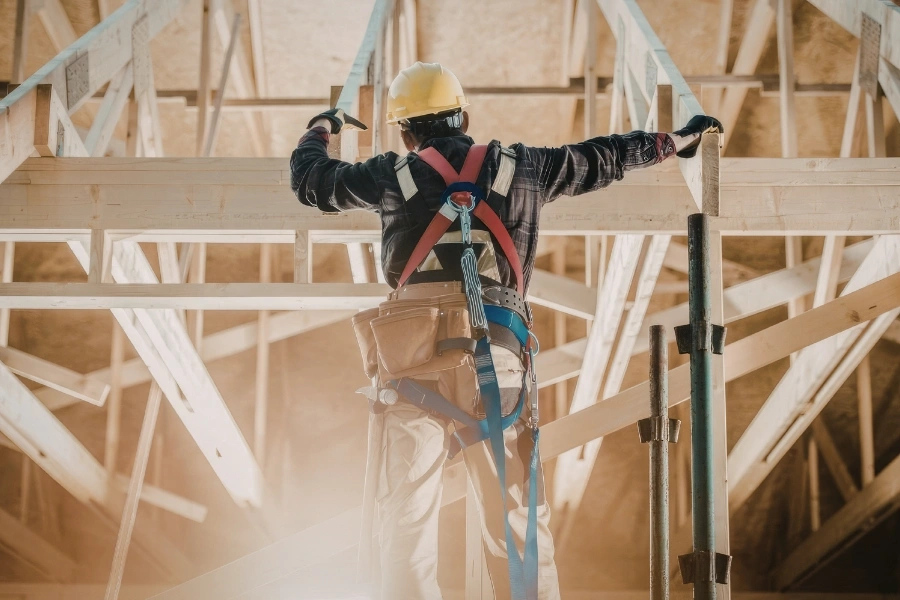
In the construction industry, material selection is a critical factor that determines a building’s strength and durability. One material that is almost always used in light-frame construction and roof framing is lumber. Unfortunately, many people still focus solely on price without understanding standard sizes or how to calculate material requirements. In fact, miscalculations can lead to cost overruns, material shortages midway through a project, or even suboptimal structural performance.
Well, surely you don’t want to face those risks, do you? To ensure your project runs more efficiently, let’s understand the standard sizes and how to correctly calculate your lumber requirements!
What Is Lumber?
Kaso is a type of wood commonly used as roof trusses, ceiling joists, lightweight formwork, and for various other construction needs. This material is typically installed over roof battens and serves to transfer the roof load to the building’s structure.
Because it plays such an important role, careful attention must be paid to the quality of the wood. Wood that is too damp or has many defects can cause the structure to warp, crack, or rot easily over the long term.
Common Standard Sizes of Kaso
In the Indonesian market, the sizes of kaso wood actually vary quite a bit. However, there are several sizes that are most commonly used in construction projects.
1. 4/6 Lumber
The actual dimensions are approximately 4 cm x 6 cm. This type is often used for ceiling frames, lightweight partitions, and non-structural construction needs.
2. 5/7 Lumber
It measures approximately 5 cm x 7 cm. This size is quite popular for residential roof frames because it offers better load-bearing capacity.
3. 5/10 Lumber
It is typically used for applications requiring greater strength, such as specific support structures or buildings with wider spans.
Standard Lengths
In addition to cross-sectional dimensions, the standard lengths of Kaso available on the market are generally 3, 4, and 6 meters. The choice of length is usually tailored to the building’s design to minimize material joints.
Functions of Kaso in Construction
Although commonly associated with roof trusses, the functions of this material are actually quite diverse, including:
- Serving as the primary support for roof purlins.
- Helping to distribute the load of the roof covering.
- Used as ceiling framing.
- Forming part of concrete formwork.
- Used in renovation projects and temporary construction work.
Given its vital role, material quality should be a priority over simply seeking the lowest price.
How to Calculate the Number of Lumber Needed?
Before purchasing materials, determine the number of roof rafters you’ll need. This helps avoid wasting your budget while also preventing material shortages during the construction process. Here’s how to do it!
1. Calculate the Area of the Roof to Be Installed
For example, a roof measures 10 meters long and 8 meters wide. Therefore, the roof area = 10 m × 8 m = 80 m²
2. Determine the Spacing Between Roof Rafters
For residential roof frames, the spacing between roof rafters generally ranges from 40–60 cm, depending on the type of roofing material and structural design. For example, let’s use a spacing of 50 cm (0.5 meters).
3. Calculate the Number of Rafter Rows
Roof width ÷ spacing
8 m ÷ 0.5 m = 16 rows
4. Calculate the Total Length of Material
Number of rows × roof length
16 × 10 m = 160 meters
If using 4-meter-long rafters:
160 ÷ 4 = 40 rafters
To account for cutting and installation errors, add a 5–10% allowance. Therefore, the final requirement is approximately:
40 pieces + 10% = 44 pieces
This calculation is a basic estimate. In actual projects, requirements may vary depending on the roof shape, pitch, and other structural details.
What Is the Ideal Spacing Between Roof Rafters?
The spacing between roof rafters is typically determined by the type of roofing material used.
- Concrete roof tiles: 40–50 cm
- Ceramic roof tiles: 40–50 cm
- Lightweight metal roofing: 60 cm or as recommended by the manufacturer
- Asphalt shingles: follow the specifications of the supporting structure
The heavier the roofing material, the closer the spacing between rafters is typically made to increase structural strength.
Therefore, understanding standard dimensions and how to calculate rafter requirements not only helps save on project costs but also ensures a stronger and more durable building structure. With accurate calculations, you can reduce the risk of material shortages or waste during the construction process
Now that you know the rafter dimensions and how to calculate them, let’s get high-quality lumber for your roof framing needs and other construction projects at Hojaya! We offer a variety of solid woods, such as Meranti Kalimantan, Kamper Samarinda, Bengkirai, Borneo Jambi, as well as supporting materials like plywood, film face, and polyfilm, all widely used in construction and renovation projects. We’re ready to support both small- and large-scale projects with consistently high quality.
Don’t let your project be held up by the wrong materials. Make sure your building material needs are well-prepared from the start so that the construction results are sturdier, more efficient, and long-lasting!
FAQ
1. What are the standard sizes for roof rafters?
The most commonly used sizes are 4/6 cm and 5/7 cm. The choice depends on the building’s design and the roof load.
2. What lengths of rafters are available on the market?
Standard lengths are typically 3 meters, 4 meters, and 6 meters.
3. What is the main function of rafters?
They support the roof sheathing and roof framing, and help transfer the roof load to the building structure.
4. What is the ideal spacing for roof purlins?
Generally, it ranges from 40–60 cm, depending on the type of roofing material and structural requirements.
5. How do you calculate the amount of lumber needed for roof purlins?
Calculate the area to be covered, determine the spacing between purlins, then calculate the total length of material needed and add an allowance of about 5–10%.