


Blog
Why Does Wood Material Expand and Shrink?

Wood does look sturdy, but it actually has quite dynamic properties. The dimensions of boards or beams can change as environmental conditions shift, particularly due to fluctuations in moisture content. This is why wooden doors can sometimes be difficult to close during the rainy season, while gaps in floors or furniture joints may appear when the air is drier.
So, why does wood expand and contract? The answer isn’t simply because wood “gets wet,” but rather has to do with the structure of wood cells and their interaction with humidity in the air. Let’s take a look at the explanation!
Water Is the Main Factor Behind Dimensional Changes in Wood Material
Wood is a hygroscopic material. This means that wood can absorb and release water vapor from its surroundings until it reaches a certain equilibrium. However, not all water that enters the wood immediately causes it to change in size. Simply put, the water in wood exists as free water in the cell cavities or as bound water attached to the cell walls.
Dimensional changes occur primarily when the moisture content of the cell walls changes. When wood absorbs moisture, the cell walls expand, causing the wood to increase in size. Conversely, when moisture is released, the cell walls contract and the wood shrinks.
There is an important threshold known as the fiber saturation point (FSP). On average, it occurs at around 30% moisture content, although this can vary among different types of wood. Below this point, changes in moisture content begin to have a noticeable effect on the wood’s dimensions.
Wood Shrinkage Is Not the Same in Every Direction
Wood is anisotropic, so the rate of dimensional change varies depending on the direction relative to the grain and the growth rings. In general:
- Tangential: the greatest shrinkage, about 6% from saturated to oven-dried conditions.
- Radial: about 4%.
- Longitudinal: much smaller, about 0.5%.
These differences explain why wooden boards not only shrink but can also warp, twist, crack, or change shape.
For example, when one side of a board loses moisture faster than the other, internal stress differences occur. In boards with a specific grain orientation, this can result in cupping, bowing, or twisting.
Therefore, the size of the wood alone is not enough to consider. The grain direction, the position of the board when cut, the moisture content, and the drying method all contribute to its dimensional stability.
Why Can Wood Shrink Even When It Is Not Submerged in Water?
When wood is placed in a room with low relative humidity, its surface releases water vapor. Conversely, a humid environment causes the wood to absorb moisture.
The wood then moves toward its Equilibrium Moisture Content (EMC), which is the condition in which the wood’s moisture content reaches equilibrium with the ambient temperature and humidity. In buildings, the EMC can vary depending on climatic conditions and the use of the space.
Therefore, wood that has just come out of storage or the drying process should not be installed immediately without considering the environmental conditions where it will be used.
Factors That Increase Wood Shrinkage and Expansion
There are several factors that cause wood to shrink and expand more significantly, namely:
- Initial moisture content
Wood with a high moisture content is more likely to undergo dimensional changes as it dries to equilibrium.
- Drying rate
Drying too quickly causes the wood’s surface to lose moisture first, while the interior remains wet. This difference in moisture content creates stress and increases the risk of defects.
- Wood Species and Density
Each species has different shrinkage characteristics. Therefore, it is incorrect to assume that all types of wood will shrink at the same rate.
- Grain Orientation
Wood with different grain patterns and cutting directions may exhibit different patterns of change.
- Environmental Conditions
Repeated fluctuations in humidity and temperature can cause wood to continuously go through cycles of absorbing and releasing moisture.
How to Reduce the Risk of Wood Expansion and Shrinkage
The key is not to try to prevent the wood from moving at all, since such movement is a natural characteristic. A more realistic approach is to control that movement.
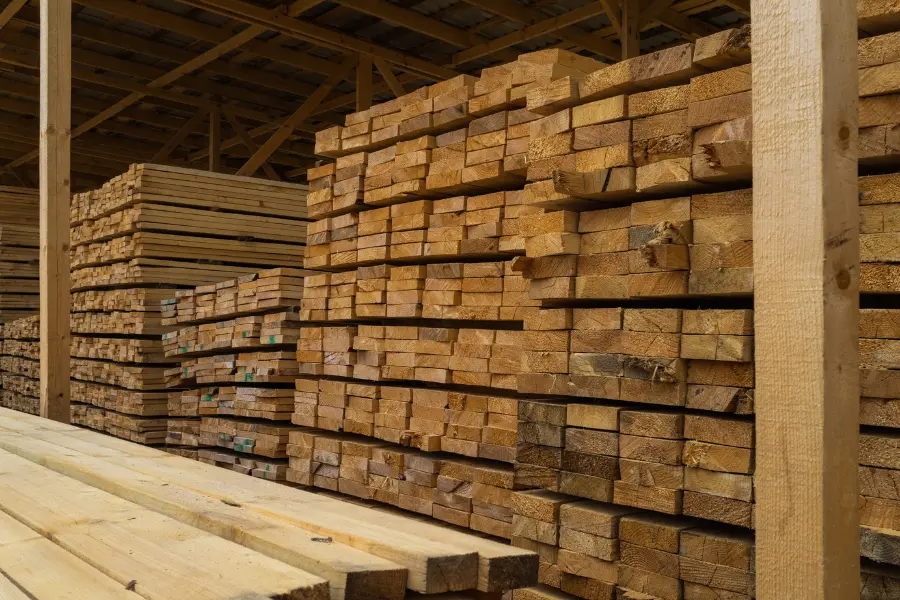
Use wood with a moisture content appropriate for the location where it will be used, dry it properly, store the material in a place protected from rain and extreme fluctuations in humidity, and allow for expansion gaps at joints that require movement.
For components that require high stability, the design must also take into account the grain direction and potential dimensional changes. That way, the natural movement of the wood does not immediately become a problem for the structure or the furniture.
Choose Wood Based on Your Project Requirements!
The bottom line is that just because wood expands and contracts doesn’t mean it’s of poor quality. These changes are a natural characteristic that you need to understand, from selection and storage all the way through installation. By choosing the right type of wood and considering the conditions under which it will be used, the risk of warping can be much more easily controlled.
Ultimately, understanding the properties of wood actually helps us choose products more carefully. Don’t just look at the price or the surface appearance; also consider the type of wood, intended use, environmental conditions, and dimensional characteristics.
Well, if you’re looking for wood for construction, furniture, or large-scale projects, Hojaya is the place to go! We offer a wide selection of solid wood, including Kalimantan Meranti, Kruing, Bengkirai, Samarinda-Oven Camphor, Albasiah, Racuk MC, and even bamboo. Don’t worry! Our materials have undergone sorting, drying, and quality control processes to ensure the quality of our supply.
So, feel free to contact us and discuss your project needs!
FAQ
- Does all wood shrink?
Yes. Almost all wood shrinks and expands due to changes in moisture content, but the extent varies depending on the species, grain direction, and drying conditions.
- When does wood begin to shrink?
Shrinkage typically becomes significant when the wood’s moisture content drops below the fiber saturation point, which averages around 30%.
- Won’t kiln-dried wood shrink?
Not entirely. Drying helps reduce moisture content and improve stability, but the wood can still absorb or release moisture after it’s been used.
- Why do wooden boards warp?
Differences in moisture content between the surface and the interior, combined with variations in shrinkage along the grain, can create stresses that cause the boards to warp or twist.
- How do you choose wood that won’t warp easily?
Choose a wood species and moisture content appropriate for the application, ensure proper drying and storage, and use joint designs that can accommodate the wood’s movement.