

Blog
Why Does Wood Need to Be Dried? Here’s How It Affects Strength and Durability

Wood is indeed a favorite material for a wide range of applications, from furniture and interior design to construction. But did you know that freshly cut wood is actually still “wet”? Its moisture content can be very high—almost equal to the weight of the wood itself. That’s why the wood drying process is so important.
The drying process isn’t just a production formality, but a crucial step that determines the wood’s quality, strength, and lifespan. So, what actually happens if wood is used without this process? Is it true that it can cause long-term damage? Let’s find out so you don’t choose the wrong material!
What Is Wood Drying?
Simply put, wood drying is the process of reducing the moisture content in wood until it reaches the ideal level for its intended use.
Wood is hygroscopic, meaning it can absorb and release water depending on environmental conditions. If moisture content isn’t controlled, the wood will continue to move, expanding when damp and shrinking when dry.
Well, the drying process is important because:
- It stabilizes the wood’s dimensions
- It reduces the risk of defects like cracking and warping
- It enhances resistance to mold and insects
The Impact of the Drying Process on Wood Strength
Many people are unaware that moisture content significantly affects wood strength. The higher the moisture content, the lower the strength. Therefore, the drying process is necessary because:
1. Higher Structural Strength
Wood that has undergone drying has a denser and more stable fiber structure. As moisture content decreases, the wood’s mechanical strength actually increases.
2. Better Load-Bearing Capacity
Dried wood can withstand pressure and loads more consistently, making it suitable for long-term construction and furniture.
The Impact of the Drying Process on Wood Durability
In addition to being strong, wood must also be durable. This is where the crucial role of wood drying becomes evident. Here are the effects of the drying process on wood durability.
1. Prevents Mold and Termite Infestations
Mold and microorganisms struggle to thrive when wood moisture content is below 20%.
2. Reduces the Risk of Cracking and Warping
Wood that hasn’t undergone the drying process will shrink after use, which can cause cracking or deformation.
3. Longer-Lasting
With stable moisture content, wood is less prone to damage even when exposed to changes in temperature and humidity.
Read also: List of Salt- and Moisture-Resistant Woods for Coastal Construction
Types of Wood Drying Methods
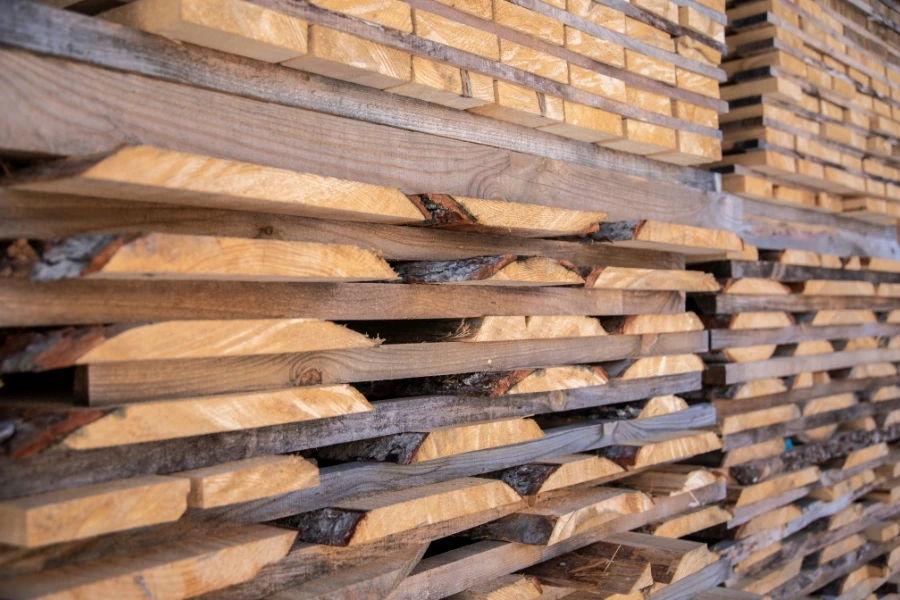
In practice, there are several common wood drying methods, namely:
- Air drying (natural drying) → Relies on air circulation
- Kiln drying (oven/furnace) → Uses controlled temperature and humidity
- Solar drying → Uses solar heat with a closed system
Each method has its advantages, but kiln drying typically produces the most stable quality because conditions can be precisely controlled.
What Is the Ideal Moisture Content for Wood?
Well, the answer depends on the application.
- Construction wood around 12–19%
- Interior furniture wood ideally below 14%
If the moisture content is too high:
- Wood is prone to warping
- Glue and finishes do not adhere properly
- Risk of damage increases
What Happens If Wood Isn’t Dried?
This is often a critical mistake. You should know that without drying, wood can become:
- Warped or bent after installation
- Cracked due to shrinkage
- Prone to mold and rot
- Strength decreases drastically
In fact, dimensional changes can occur continuously because the wood has not yet reached moisture equilibrium with the environment.
So, wood drying isn’t just an optional process that can be overlooked, it’s crucial for determining the wood’s quality. From strength and dimensional stability to the wood’s resistance to weather and fungal attacks, everything is heavily influenced by how effectively the moisture content is controlled. Without this process, the wood may look good at first, but it risks causing problems down the line.
Well, for wood that guarantees a neat, durable, and low-risk final project outcome, you can trust Hojaya! We provide solid wood that has undergone standard drying processes. Additionally, we offer plywood, film-faced panels, and polyfilm that have been properly processed, making them more stable, less prone to warping, and ready for use in various applications from small-scale projects to large-scale ones.
The bottom line is, don’t make the wrong choice. Wood that hasn’t been properly dried can actually lead to additional costs for repairs or replacements. So, it’s better to invest from the start in materials with guaranteed quality, so the results are optimal and long-lasting.