

Blog
Best Wood Material for Office Workstations and Partitions

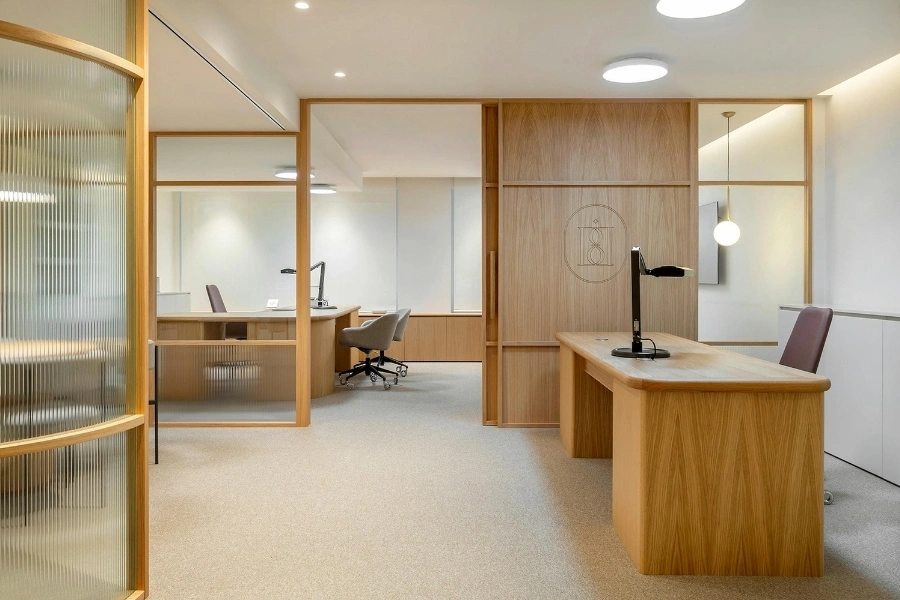
Selecting wood material for office workstations and partitions involves more than just considering color or grain patterns. Office areas see daily use, so materials must withstand equipment loads, friction, humidity fluctuations, and long-term maintenance requirements.
For workstations, the surface must be strong enough to support laptops, monitors, documents, and various work supplies. Meanwhile, partitions require stable materials that resist warping or deformation. Therefore, factors such as wood type, moisture content, dimensions, construction method, and finishing need to be considered from the outset.
Let’s explore the best wood recommendations for these needs!
Wood Material Options for Office Workstations
Workstations require specific wood characteristics depending on the load, design, and intensity of use. Here are some wood types for your consideration:
1. Kamper Samarinda
Kamper Samarinda is an excellent choice when a desk requires a combination of strength, attractive grain patterns, and good durability. This wood offers good resistance to both termites and moisture.
For workstations, Kamper wood can be used for both the surface and structural components, depending on the furniture’s size and design. Proper drying is crucial, as wood used for interiors must maintain a moisture content suited to the room’s conditions.
2. Meranti Kalimantan
If your project requires a balance between cost and ease of fabrication, Meranti is an appealing option. Meranti is classified within strength classes II–III, making it suitable for basic furniture, door frames, framing, and interior elements.
Meranti’s ease of workability makes it ideal for office furniture projects requiring numerous components with specific shapes. However, for desks subject to heavy loads or intensive use, structural design and board thickness remain critical factors; the wood type alone does not determine the desk’s final strength.
3. Kruing
Kruing is also worth considering for furniture requiring superior strength. Classified as strength class II, Kruing is dense and robust, commonly used for structural beams, wood flooring, and heavy-load-bearing components. For office desks, this type of wood can be utilized in areas requiring high strength. However, the final choice must still take into account factors such as the desk’s span, material thickness, joinery system, and the anticipated load.
4. Bengkirai
Bengkirai is renowned as a highly durable hardwood. Classified within strength classes I and II, it is used for applications ranging from decking, carports, and exterior construction to heavy-duty structural work.
For indoor office desks, Bengkirai might not be the most economical choice if such extreme strength isn’t required. However, it is an attractive material for projects that prioritize durability or feature an interior design concept that highlights the character of hardwood.
What About Materials for Office Partitions?
Office partitions have different requirements compared to desks. The focus shifts from mere strength to factors such as weight, stability, ease of installation, and aesthetics.
For non-structural interior partitions, relatively lightweight wood can be more practical. Hojaya, for instance, supplies Albasiah wood known for being lightweight and economical which is suitable for light construction, interior partitions, and non-structural furniture components.
Meanwhile, Meranti is a good option when the partition requires a sturdier frame. You can also combine it with plywood facing panels to enhance structural stability and achieve a uniform finish more easily.
In short, not all partitions require hardwood. In fact, using overly heavy wood material can result in inefficient construction if the partition’s primary function is simply to divide space.
Tips for Making Wooden Tables and Partitions Last Longer
Selecting the right wood material is just the first step; durability is also heavily influenced by the production process and actual usage. Here are key factors to consider:
- Ensure the wood undergoes a proper drying process.
- Avoid using boards with excessively high moisture content for interiors.
- Match the board thickness to the table’s span.
- Use construction methods and joints capable of supporting the load.
- Protect the surface with an appropriate finish.
- Avoid direct contact with water or sources of moisture.
- Provide extra protection for areas prone to spills.
- Inspect the wood’s condition before production to avoid defects or damage.
For long tables, strength isn’t determined solely by board thickness. The placement of table legs, support frames, and load-bearing points is crucial in determining the risk of sagging over long-term use.
Choose Wood Based on Function, Not Just Appearance!
Every type of wood has unique characteristics. The best material isn’t always the most expensive or the hardest. The most important thing is to select the wood type based on function, load, room conditions, design, and processing quality.
But don’t worry! Hojaya supplies solid wood including Meranti Kalimantan, Kamper Samarinda, Kruing, Bengkirai, Albasiah, Racuk MC, Borneo Jambi, Bambu, and Dolken Gelam for construction, interior, and furniture workshop needs.
For office projects requiring large quantities of material, stock consistency is equally important. You certainly wouldn’t want production to halt because the required wood type or size suddenly becomes unavailable. We offer high supply capacity, sorting and quality control processes, and consultation services to help match the wood to your project’s specific needs.
So, if you are preparing a large number of work desks, workstations, or office partitions, feel free to contact us directly!
FAQ
1.What types of wood are good for office work desks?
Woods with good strength and stability, such as Samarinda Kamper or Kruing, are worth considering. For more economical needs, Meranti is also a viable option when used with the right construction.
2. Is solid wood more durable than plywood?
Not necessarily. While solid wood is strong and can be repaired or refinished, high-quality plywood also offers good stability. Ultimate durability depends on material quality, construction, finishing, and maintenance.
3. Is Albasiah suitable for office partitions?
Yes, it can be used—especially for non-structural interior partitions that require a lightweight, economical material. However, the frame and panel design must still be tailored to specific requirements.
4. Is Bengkirai suitable for office desks?
Bengkirai is very strong and durable, but using it for indoor desks requires weighing factors such as cost, weight, and actual strength requirements. For standard desks, other wood types may be more efficient.
5. What causes wooden desks to deteriorate quickly?
Improper wood moisture content, weak construction, excessive loads, high humidity, poor finishing, and a lack of maintenance. Therefore, wood selection should be considered alongside the construction planning.